


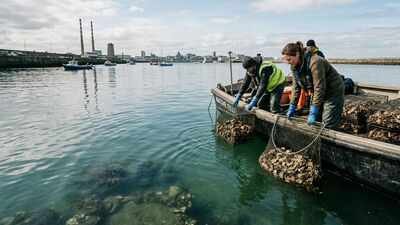
For more than two centuries, native oysters were absent from Dublin Bay. That changed with a restoration project that is now placing thousands of the shellfish back into the harbour at Dún Laoghaire. As reported by Irish Times, in November 2025, more than 18,000 native Irish oysters were introduced in floating baskets along the middle pier, forming the latest stage of an effort to establish a living oyster reef. The oysters are not intended for commercial harvesting. Instead, they are being used as part of a wider experiment in marine restoration, with hopes that their filtering activity will improve water conditions while future reefs could help steady the seabed and soften wave energy along the coast.
More than 18,000 oysters are being given a new home in Dublin Bay
According to Irish radio and public service broadcasting (RTE 100), the release took place at Dún Laoghaire Harbour, where 20 volunteers helped put more than 18,000 adult native oysters into specialised floating flip baskets. The shellfish had been harvested from waters off County Kerry before being brought to Dublin. Their purpose is ecological rather than commercial, with the project designed to create the conditions for a new oyster population to become established.The work is being led by the Green Ocean Foundation, which has been testing oyster gardens at several locations around Dublin Bay. Howth, Malahide and Poolbeg have already formed part of the trial, while Dún Laoghaire has become a major focus as the organisation works towards establishing oysters along the harbour’s hard coastal structures.The choice of oysters is partly about what happens beneath the surface. A living reef is not simply a collection of shellfish. As oysters grow and reproduce, their shells can create hard surfaces where further oysters can settle, gradually changing the structure of the seabed and harbour environment.
How oysters could help filter Dublin Bay’s seawater
As reported by Green Ocean Foundation Director David Lawlor in DCU Water Institute, the project says an individual oyster can filter roughly 190 to 200 litres of seawater a day, taking particles and nutrients such as nitrates from the water as it feeds. The intended effect is a clearer water column, which can allow more light to reach marine plants below.That process is important because the project is not treating the oysters as an isolated clean-up device. The wider aim is to encourage a chain of ecological changes. Cleaner water and improved conditions could support seagrass and seaweed, while the developing reef would provide additional surfaces and shelter for marine organisms.The project’s own plans look towards a self-sustaining broodstock in Dublin Bay rather than simply maintaining the oysters that have already been introduced.

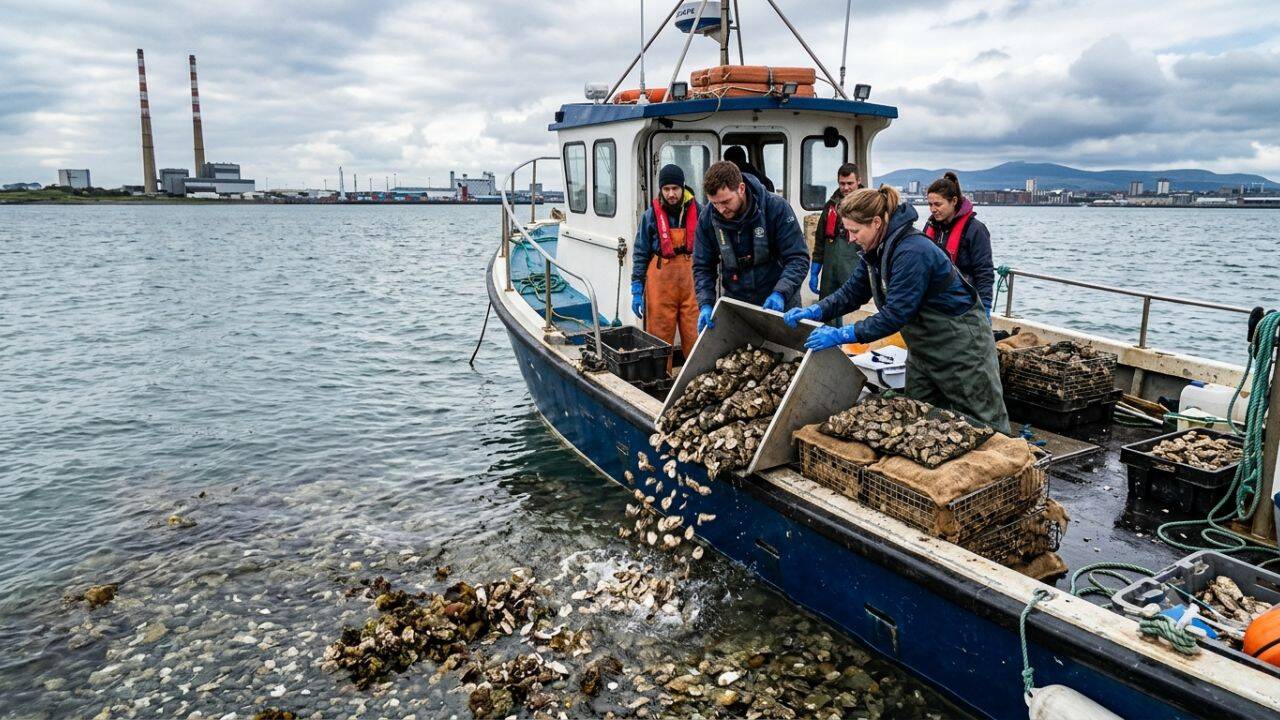
How a small oyster trial grew into a larger reef restoration project
As reported by DCU Water Institute, the first stage of the Dublin Bay Oyster Reintroduction Project began in November 2023, when 50 oyster garden baskets were installed across Dún Laoghaire, Malahide and Poolbeg. By October 2024, another 70 gardens had been added at sites including Howth.The early work also provided an important sign that the oysters could reproduce in their new surroundings. Female oysters in the baskets released between one million and 1.5 million eggs. Once fertilised, oyster larvae can settle onto suitable hard surfaces, including rocks, harbour structures and existing oyster shells. That is the mechanism the restoration project hopes will eventually allow a reef to build itself rather than relying indefinitely on new introductions.The DCU Water Institute is involved in overseeing the project and has reported strong growth, survival, reproduction and settlement during the trials. The November 2025 release therefore represents an expansion of an experiment already underway, rather than a standalone stocking operation.
Coastal protection role of an oyster reef
Water filtration is only part of the proposed benefit. Once established, oyster reefs can alter the physical conditions around them. Their structures can help stabilise sediment on the seabed and reduce the movement of suspended material through the water.The project also sees a possible role in limiting coastal erosion. A reef can interfere with wave energy before it reaches the shoreline, creating a form of natural protection. The restored oysters are being considered as part of an approach that could support marine habitats while helping reduce erosion by calming wave action.That does not mean the 18,000 oysters have already created such a protective reef. The current installations are part of a much longer process. The project has estimated that developing established oyster reefs could take 15 to 20 years.
Project is being built around reproduction
For the restoration team, getting oysters to survive is only the first hurdle. A lasting population needs reproduction and successful settlement of new oysters. That is why the observations from the earlier baskets matter. The release of eggs demonstrated reproductive activity, while the settlement of young oysters on available hard surfaces offers a route towards natural expansion. If those stages continue to work, the number of oysters could eventually increase without every new generation needing to be placed there by hand.The intended end point is a self-sustaining population of native European flat oysters in Dublin Bay. The species being used in the project are sourced from the Tralee area before being introduced to suitable harbour locations around Dublin.
A restoration project that began with small baskets
The scale of the latest release can obscure how modest the project was at the beginning. The initial installations used relatively small oyster gardens to test whether native oysters could survive, reproduce and settle successfully in different parts of Dublin Bay.The subsequent expansion has allowed the team to work across several sites rather than relying on one location. Dún Laoghaire, Malahide and Howth have all featured in the project, while Poolbeg was among the original locations. That gradual approach also gives the researchers and project organisers a chance to observe how the oysters behave in different harbour conditions. Future work is expected to connect restoration activities with measurable ecological outcomes, providing a stronger scientific basis for assessing what happens as the project grows.
Dublin’s missing oysters could become part of its coastline again
The restoration has a historical dimension as well as a biological one. Native oysters disappeared from Dublin Bay more than 200 years ago, leaving the current project to recreate a population rather than simply increase an existing wild stock.The 18,000 oysters now suspended in baskets at Dún Laoghaire are therefore better understood as the starting material for a much larger experiment. The immediate work involves keeping them alive and monitoring their development. Beyond that comes reproduction, settlement and the gradual accumulation of shells that could turn individual oyster gardens into a functioning reef.If the approach continues to work, the organisers have identified other locations for expansion, including Greystones in County Wicklow. For now, though, the focus remains on establishing the oysters in Dublin Bay and finding out whether a population absent for two centuries can become a permanent part of the harbour’s marine environment.