


US President Donald Trump on Monday said that preventing Iran from acquiring a nuclear weapon remains his top priority, as the 60-day deadline under the June US-Iran memorandum of understanding expired without a permanent peace agreement.In a post on X, Trump said, “The number one Goal is, and always will be, that Iran cannot have, in any way, shape, or form, a Nuclear Weapon. Thank you for your attention to this matter! President DONALD J. TRUMP”

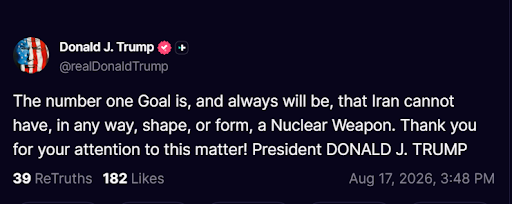
US President Donald Trump reiterated that preventing Iran from acquiring a nuclear weapon remains his administration’s “number one goal”, amid continued tensions between Washington and Tehran over Iran’s nuclear programme. (@realDonaldTrump)
Trump’s statement came as the deadline set under the June agreement expired with the Strait of Hormuz still restricted and substantive negotiations on Iran’s nuclear programme yet to resume.The interim agreement was intended to halt hostilities and provide a framework for negotiations towards a permanent settlement covering the conflict and Iran’s nuclear activities. It also envisaged restoring commercial passage through the Strait of Hormuz.Instead, the agreement has unravelled amid accusations from both Washington and Tehran that the other side breached its commitments.
Hormuz remains key sticking point
Under the June memorandum, Washington was expected to end its naval blockade within 30 days, while Iran committed to using its “best efforts” to ensure safe, toll-free commercial passage through the Strait of Hormuz for 60 days.Those commitments broke down within weeks.Iranian forces later fired on vessels travelling through a corridor near Oman overseen by the US military. Washington responded with strikes on Iran, after which Tehran attacked countries hosting US forces, including Jordan, Kuwait and Bahrain.The US subsequently restored its blockade of Iranian ports and cancelled waivers that had allowed Iranian oil exports under the interim arrangement. Both sides accused each other of violating the memorandum.Iran has since made the full reopening of Hormuz conditional on an end to the US blockade, the withdrawal of American forces from around Iran and compensation for damage caused by the war.The two sides also remain divided over control of the waterway. Trump has claimed the US has “total control” of Hormuz, while Iran’s military leadership has said no vessel can pass without Tehran’s permission.
Commercial traffic through strait plunges
The dispute has sharply reduced shipping through one of the world’s most important energy routes.According to ship-tracking data cited by AP, only five commodity vessels crossed the Strait of Hormuz on Saturday and none on Sunday, compared with 31 during the previous weekend. Before the war, more than 130 ships typically crossed the waterway each day.The latest decline followed attacks involving tankers operated by Abu Dhabi National Oil Company. The UAE has accused Iran of responsibility for three incidents involving ADNOC-operated vessels and called for Hormuz to be fully reopened.The disruption has also affected global energy markets. Brent crude reached a session high of $89.40 a barrel on Monday as traders assessed the diplomatic impasse and renewed risks to shipping.Iran has also been discussing arrangements with Oman for managing traffic through the waterway. Regional sources cited in the supplied report said Tehran had sought fees equivalent to 5% to 7% of cargo value, while Oman had proposed about 3% and Washington wanted vessels to transit without fees.
Nuclear talks remain stalled
The other major objective of the June agreement, negotiations over Iran’s nuclear programme, has also made little progress.Iranian officials say direct negotiations with Washington stopped in June, although messages have continued to pass between the two sides through intermediaries.Trump has maintained that discussions are continuing and has periodically spoken of progress. However, Iranian Foreign Minister Abbas Araqchi said over the weekend that Tehran had not decided to resume talks with Washington.A senior Iranian source told Reuters last week there had been “absolutely no progress” towards reviving the interim agreement. The source also rejected suggestions that the 60-day window had been extended, arguing that US violations meant the period had never begun from Tehran’s perspective.Trump declared the memorandum “over” on July 7, while Iran formally suspended it about a week later.
Pakistan continues push for talks
Pakistan, which helped broker the June agreement, has continued efforts to bring Washington and Tehran back to formal negotiations.Islamabad had expressed hope that the deadline could be extended and has continued urging both sides to return to the negotiating table.“We are not closing the chapter,” Pakistan foreign ministry spokesman Tahir Andrabi said last week. “Pakistan is making all-out efforts to bring the two parties to the negotiating table.”The June agreement allowed the 60-day period to be extended by mutual consent, but no extension has been agreed.
What happens after 60-day deadline?
The expiry of the deadline does not resolve the underlying disputes between Washington and Tehran. Instead, both sides remain divided over the issues that were supposed to form the basis of a broader settlement.For Iran, reopening Hormuz is tied to ending the US blockade, withdrawing American forces and securing compensation for wartime damage. Washington has rejected Tehran’s demand for reparations and continues to use sanctions and the blockade to increase economic pressure.The prolonged standoff has damaged Iran’s economy, with inflation rising and energy shipments disrupted. Further deterioration could also fuel domestic unrest.For Washington, the choices remain difficult. Accepting Tehran’s terms could give Iran a greater role in managing a waterway through which a large share of global oil and liquefied natural gas traditionally moves.A fresh military escalation could further strain US missile-defence supplies, disrupt global energy markets and put upward pressure on fuel prices.With the 60-day window now expired, Trump’s latest statement makes clear that Iran’s nuclear programme remains Washington’s central concern. But the peace push remains stuck over two unresolved issues: Iran’s nuclear activities and the future control and operation of the Strait of Hormuz.