


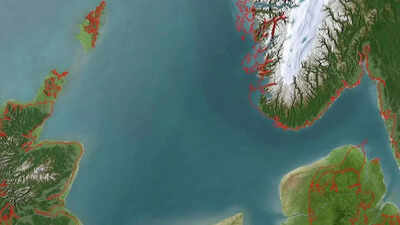
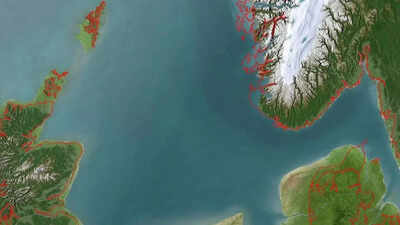
What makes things strange sometimes is when we see something for a long time, and it suddenly disappears. Eventually, the same thing happened with a land bridge that used to connect Britain and Europe. Thousands of years ago, Britain and Europe were connected by a bridge, Doggerland. This large area contained a variety of different natural environments; many animals and plants could be found in abundance. Humans had been present in this region for thousands of years; they had hunted animals and created shelters in places that would prove to be among the most successful in the British Isles.According to reports, this ‘lost world’ began to disappear about 8,200 years ago, at the conclusion of the last ice age, with melting ice shifting ocean levels upward, which in turn created vast areas of marshland through the submergence of forest. About 8,200 years ago, an extraordinarily large submarine landslide happened near the northern shore of Europe, resulting in a huge tsunami that struck many parts of this area, flooding everything but a few regions that were still above water.
Why Doggerland is a climate warning for our future
Comprehending the history of Doggerland’s disappearance is an important aspect of modern coastal communities’ possible adaptation to the impact of global warming in the present day. As noted in Smithsonian Magazine, it is estimated that the sea level rose approximately 6 feet every 100 years following the warming period at the end of the last Ice Age. According to the University of Sheffield, early Doggerlanders moved up in elevation with no difficulty; the population density and developed infrastructure of our current coastal population would severely limit their ability to migrate today. As scientists study submerged peat and sediment layers in the North Sea, new models are being produced to determine how fast our own shorelines may change. This ‘lost world’ serves to illustrate that when the climate changes dramatically, the entire map of the globe can be completely altered in only a few generations.
Could this happen today
The answer to this is yes. The current climate models by the IPCC suggest sea levels could possibly rise by several meters by 2300, echoing the same patterns that drowned Doggerland many years back.
Can someone visit Doggerland
Although it’s not possible to walk on Doggerland, the remains of Doggerland can be investigated through artefacts and other remnants of this lost land that are located throughout the world. Doggerland itself consists of land that is located 15-40 meters below the North Sea and surrounded by the dangerous and murky waters of this sea. The National Museum of Antiquities, which is located in the Netherlands, has an extensive collection of artefacts, such as mammoth teeth, flint tools, and other curiosities that were obtained from the seabed in the North Sea.Furthermore, people can visit Doggerland in a digital format, since the University of Bradford is creating a series of 3D reconstructions that accurately depict the ancient hills, rivers, and other parts of Doggerland that have been submerged beneath the ocean for thousands of years.