




Indians are increasingly moving away from traditionally mainstream and for many the “only choice of engineering & medicine”
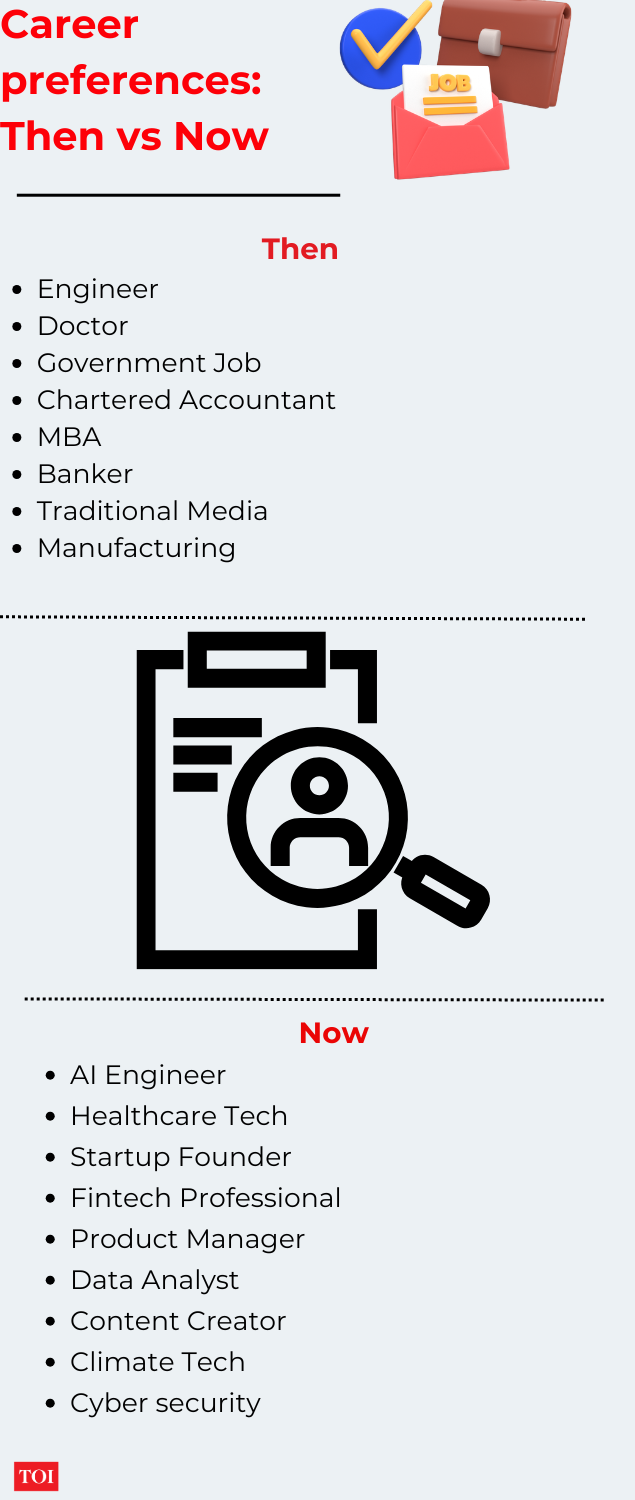
“My son will become an engineer.”“My daughter will be a doctor.”For decades, statements like these defined middle-class ambition in India.From coaching centres to family gatherings, engineering and medicine became shorthand for success; careers that promised stable incomes, social prestige and upward mobility. Parents encouraged them, schools celebrated them and students chased them, often believing there were few equally respectable alternatives.That equation, however, is quietly changing.The shift is unfolding alongside one of the biggest transformations in the global job market. The World Economic Forum’s Future of Jobs Report 2025 estimates that by 2030, structural changes in the labour market will create 170 million new jobs, while 92 million existing roles could be displaced. The report also projected that 39 per cent of workers’ existing skills will be transformed or become outdated.Thus, while engineering and medicine remain among India’s most sought-after professions, they are no longer the only mainstream aspirations for a generation entering a labour market transformed by artificial intelligence, digital businesses, startups, renewable energy and an increasingly skills-first economy.Let’s break down India’s shift career landscape
Engineering medicine still matter
The dominance of engineering and medicine continues to be reflected in India’s higher education landscape.According to the All India Survey on Higher Education (AISHE) released by the Ministry of Education, Engineering and Technology remains the largest discipline within technical education, accounting for the highest enrolment among technical courses. The scale of engineering education is spread across thousands of institutions nationwide, underscoring its enduring appeal among students.Medical education, too, has expanded significantly over the past decade. According to the National Medical Commission (NMC) and the Union Health Ministry, India has more than doubled the number of medical colleges since 2014, leading to a substantial increase in MBBS seats. The expansion has been driven by the establishment of new government and private medical colleges, particularly in underserved regions, to address the country’s doctor-to-population ratio.Competitive examinations tell a similar story. Every year, millions continue to compete for engineering and medical seats through entrance examinations such as JEE and NEET.There is a reason generations of parents gravitated towards these professions.For families that lived through economic uncertainty, engineering and medicine represented certainty. An engineering degree often meant campus placements, multinational companies or opportunities overseas. Medicine promised steady demand regardless of economic cycles, along with immense social respect.Unlike many careers where income depended on market conditions, these professions came with relatively predictable trajectories.For many parents, encouraging these careers wasn’t about limiting ambition but about reducing risk.

How the jobs scenario has changed
The changing definition
Outside campuses, the definition of a “good career” is becoming far broader.The Indian economy of 2026 bears little resemblance to that of two decades ago.India today hosts one of the world’s largest startup ecosystems. Global Capability Centres continue expanding into multiple cities. Digital commerce, fintech, creator businesses, gaming, climate technology and artificial intelligence have opened occupations that barely existed when today’s parents entered the workforce.That transformation is changing hiring itself.“Engineering and medicine continue to be among India’s most preferred career choices, driven by their perceived stability, social prestige and long-term earning potential. However, we are seeing a gradual but meaningful shift, particularly among younger professionals and urban talent,” said Balasubramanian A, senior vice president at Indian recruitment firm TeamLease Services.Government initiatives supporting manufacturing and innovation, such as Make in India, the Production Linked Incentive (PLI) schemes, coupled with India’s startup ecosystem, are also widening employment opportunities beyond traditional professions, he says.
Degree or skills? What matters
Perhaps the biggest shift is happening in recruitment.Employers increasingly want evidence that candidates can perform the job; not merely that they hold a degree.According to TeamLease senior VP, “employers are increasingly hiring for skills over degrees, although the importance of formal qualifications still depends on the role and industry. For many jobs today, especially those linked to technology, manufacturing, logistics, healthcare, retail and customer operations, the ability to perform the job effectively often carries more weight than the qualification itself.”According to Balasubramanian A, the fastest-growing skills are no longer confined to software coding alone. Employers are seeking expertise in artificial intelligence, cloud computing, cybersecurity and data analytics alongside practical technical skills such as electrical maintenance, quality inspection, machine operation, warehouse management and field services.Beyond technical capabilities, communication, adaptability, teamwork, analytical thinking and a willingness to continuously learn have become equally important across industries, he added.
Young Indians redefining ‘mainstream’
A small independent survey conducted for this story reflects the broader shift in mindset.Around 80 per cent of the 30 respondents said engineering and medicine are no longer the only “safe” career choices. Nearly nine in 10 said they would encourage the next generation to explore career options beyond the traditional professions, with many saying skills, adaptability and personal interests now matter more than simply following conventional career paths. Artificial intelligence, data science and cybersecurity emerged among the careers most frequently identified as offering the strongest opportunities over the next decade.Several respondents also believed future success would depend less on degrees and more on adaptability.For Tripti Kumar, who recently graduated as BSc Home Science student, the decision came from recognising that her interests lay elsewhere. She said she realised engineering and medicine were never the right fit because she was more interested in human development, nutrition, family studies and community well-being. “I wanted a career where I could work closely with people and make a positive impact on their lives,” she said, explaining why she chose Home Science.A psychology student in college also felt encouraged to go beyond. She said she realised in Class 10 that engineering and medicine were not the right path after developing a keen interest in understanding people and their behaviour. Although some relatives felt engineering and medicine were “better career choices”, but she never felt pressured to pursue them. “It was worth it because I am studying what I enjoy,” they added.Unlike many students who face pressure to pursue conventional professions, she said her parents trusted her judgement. Their support gave her the confidence to pursue Home Science “without any hesitation.” Additionally, looking back, she believes the decision has paid off. The course, she said, has strengthened her practical knowledge, communication skills and confidence. “Most importantly, I enjoy what I study, and that makes the journey meaningful and rewarding.“However, the traditional paths have not lost relevance. “Someone has to become doctor and engineer, so it should always be a career option,” said Shivendra Singh, a media professional reflecting a sentiment that these professions remain indispensable even as choices expand.Meanwhile, one respondent working in the media sector said, “even people with degrees in medicine or engineering are pivoting to content creation and slowly making it their primary focus,” citing the rapid growth of the creator economy.Echoing a similar sentiment, Durgesh Kumar Jha, PR professional at Kalka Co. Media Consultancy, said “Engineering and medicine remain respected professions, but today’s youth are embracing diverse fields like communications, digital media, entrepreneurship, design and technology. What matters most is aligning one’s passion and skills with the opportunities of a rapidly changing world.”The changing mindset isn’t unique to India.According to Deloitte’s 2026 Gen Z and Millennial Survey, younger professionals are increasingly defining career success on their own terms rather than through conventional milestones.The report found that financial pressures continue shaping career decisions, while workers are investing heavily in new skills, viewing adaptability as a core career capability. AI adoption has also become mainstream, with nearly three-fourths of Gen Z and millennial respondents already using AI at work, not only to improve productivity but also to identify learning opportunities and seek career advice.
Many more options have come up for people
The jobs likely to define next decade
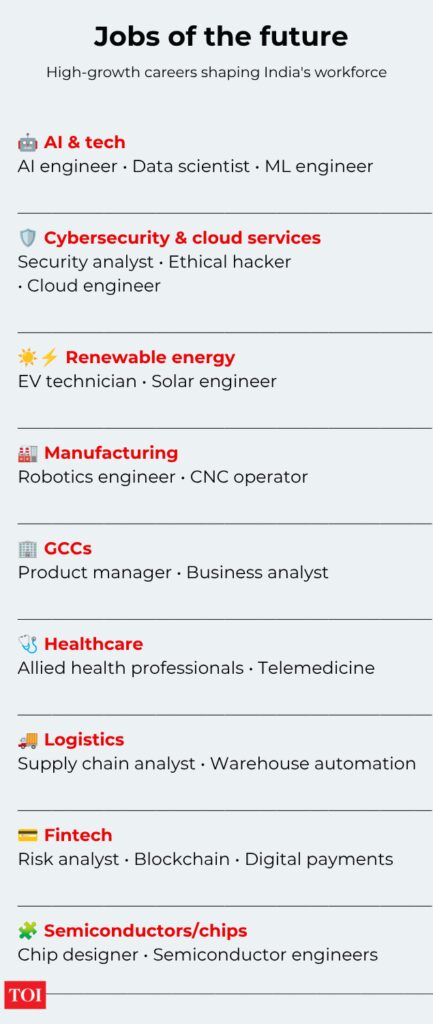
According to TeamLease, employment growth over the next five to ten years is expected to come from a much wider range of sectors than previous generations experienced.Global Capability Centres, manufacturing, renewable energy, healthcare, logistics, retail, e-commerce, BFSI and telecom are expected to remain major recruiters.Demand is also projected to remain strong for AI professionals, cybersecurity specialists, software developers, EV technicians, healthcare workers, production operators and logistics professionals.Srishti, senior executive working in Regulatory intelligence and market research believes the change is already visible, “That era (dominance of engineering,medicine, etc.) is over. The digital economy and AI have created massive, high-paying career paths beyond traditional fields. Today, skills in UI/UX design, data science, cybersecurity and digital marketing offer equal financial success and better work-life balance,” she said.The World Economic Forum’s 2026 report on entry-level work added that AI is reshaping, not eliminating, early careers. Rather than replacing graduates outright, it argues employers will increasingly value work-integrated learning, applied problem-solving, technological exposure and alternative signals of job readiness alongside traditional degrees.
Beyond ‘safe careers’
For generations, the idea of a “safe career” in India was closely tied to a handful of professions. But as industries evolve, technology reshapes workplaces and entirely new job roles emerge, that definition is changing.TeamLease’s Balasubramanian said, “The focus should no longer be on choosing a ‘safe’ career for life, but on building adaptable skills that remain relevant as industries evolve.”Ultimately, the answer may lie in balancing the reliability of traditional careers with the freedom to explore new opportunities. As Silky Mahajan, working as a marketing employee for a startup said, “We need to balance reliable traditional careers like engineering and medicine with modern technology. To succeed today, the next generation must combine these stable fields with essential skills like analytical thinking, leadership, and AI awareness.“Long-chosen careers like engineering medicine and law are unlikely to lose their stature anytime soon. But they are no longer the only answer when someone asks a child what they want to become.In today’s India, the more relevant question may be less about which profession is safest, and more about which skills and fields will stay valuable.