


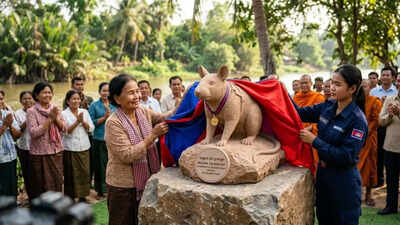
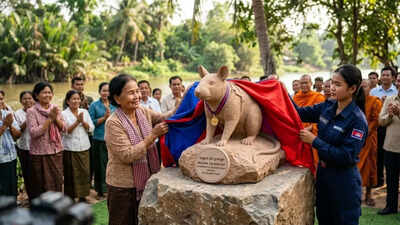
Cambodia has erected a statue to commemorate Magawa, the African giant pouched rat celebrated for his remarkable olfactory skills and life-saving work. The monument was unveiled in Siem Reap on April 3, 2026. Over five years of dedicated service as a HeroRAT, Magawa located over 100 landmines and unexploded ordnance, clearing more than 141,000 square meters of land. His training allowed him to ignore scrap metal and focus solely on the faint scents of explosives, resulting in landmine clearance that was both safer and quicker than conventional methods.By erecting a sandstone statue of Magawa in Siem Reap, Cambodia is honouring both animal intelligence and the humanitarian effort to remove landmines from the landscape. The story of this little rodent is a testament to the innovative ways that non-technical approaches to demining have helped restore safe living conditions to communities reeling from conflict and war.
The record-breaking career of Cambodia’s landmine-sniffing rat Magawa
Siem Reap has erected a permanent sandstone monument to commemorate Magawa, whose unparalleled contribution to humanitarian demining makes him a true hero in the eyes of the community. Trained as a HeroRAT by a tenured organisation, APOPO, Magawa was the most accomplished HeroRAT in APOPO’s history, successfully identifying 71 landmines and 38 items of unexploded ordnance (UXO) during his tenure while releasing land equivalent to 20 football fields back to the community.
Why Magawa could ignore scrap metal
Magawa’s operational efficiency over time was phenomenal; he could clear an area the size of a tennis court in as little as 20 minutes (compared with a human using a metal detector who would typically take 4 days to accomplish the same task). Cricetomys ansorgei (African Giant Pouched Rat) was chosen for detecting mines due to the presence of specific physiological and behavioural characteristics identified through veterinary research studies. Scientific studies confirm that these rats possess a highly sensitive olfactory system capable of detecting minute concentrations of explosive vapour, allowing them to ignore scrap metal and signal only the presence of TNT. Their low body mass enables them to safely traverse pressure-activated landmines without triggering pressure-sensitive detonators, allowing them to directly traverse land that would either kill a human deminer or a larger detection animal like a dog.
Why biological detection is the faster path to safety
Magawa’s work was a humanitarian effort that complied with an extensive list of regulations from the International Mine Action Standards (IMAS) global safety protocols. IMAS integrates animal detection systems into technical surveys so that authorities can return land to communities for agriculture and housing with a high level of confidence.Because these rats are trained to sniff out explosives, they generate fewer false alarms compared to conventional sensors. This, in turn, accelerates the entire process of reclaiming land for families displaced by conflict.
The first rat to ever receive this honour from PDSA
Magawa’s contributions were acknowledged worldwide in 2020, a pivotal moment for animal detection systems in international security. He made history as the first rat, in the People’s Dispensary for Sick Animals (PDSA) 77-year existence, to be presented with the Gold Medal – an accolade akin to the George Cross for animals.