


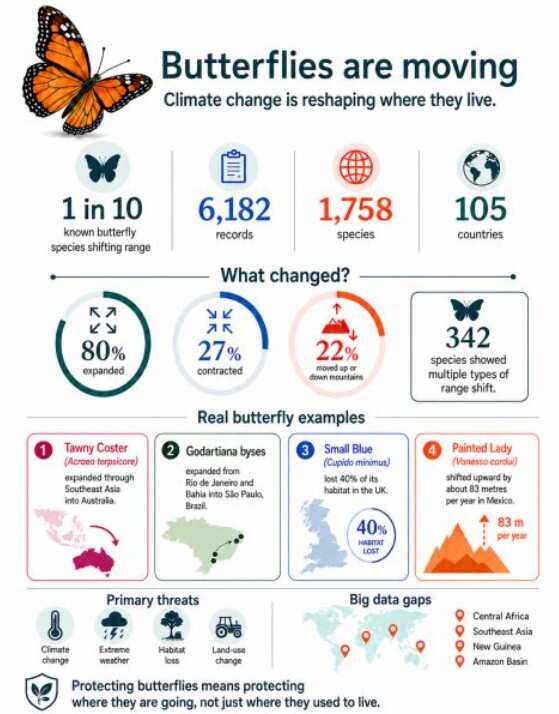
Butterflies are relocating across the world as climate change and extreme weather continue to alter their habitats. According to a new global study, many species are expanding into new areas, while others are disappearing from places where they once thrived.The study, published in Nature Ecology & Evolution, analysed changes in 1,758 butterfly species across 105 countries. It found that about one in every 10 species has either expanded or reduced its geographic range or moved to different elevations in response to changing environmental conditions.Scientists say butterflies are among the first animals to respond to environmental changes, making them important indicators of what is happening across ecosystems. Their movement could be an early sign of wider changes that may eventually affect many other plants and animals.According to study’s lead author Dr Shawan Chowdhury, head of Monash University’s Global Change Ecology Lab, the findings show the scale of the changes taking place around the world.“Butterflies are early-warning indicators and are signalling a warning across the entire planet. If their ranges shift this dramatically, it signals profound changes across ecosystems,” Chowdhury said as quoted by The Guardian.
Expanding and shrinking together
80% of butterfly species that changed their range expanded into new areas. Many of these species moved into places that have become suitable as temperatures increased.Though this shows how quickly some species can respond to changing conditions, it does not necessarily mean the butterfly is thriving. A species may spread into new locations but still struggle if those habitats are not ideal.An example of this is the tawny coster butterfly, which is native to India, Bangladesh and Sri Lanka. The butterfly was first recorded in Australia in 2012 and has since spread at a rate of about 135 kilometres each year.Not all butterfly species are expanding. The study found that about 27% of the species that shifted experienced shrinking ranges, disappearing from areas where they had previously lived. Among them is Cupido minimus, the United Kingdom’s smallest butterfly.Meanwhile, some butterflies also changethe altitude at which they live, moving either higher or lower depending on local environmental conditions.

Climate change and extreme weather were major drivers behind butterflies relocating (Picture: LinkedIn/Dr Chowdhury)
The study found different patterns across the world. Range expansions were recorded on every continent where butterflies are found, with many occurring in tropical regions. In contrast, range contractions were mainly reported in Europe and North America. Most changes in elevation were recorded in the Northern Hemisphere.Scientists also found a more complex pattern in some butterfly species. Instead of only expanding or only shrinking, they were gaining habitat in one part of their range while losing it elsewhere.Dr Chowdhury says this creates uncertainty about their future; “You don’t really know what’s going to happen for that species, whether they’re going to be endangered or whether they are going to be least concern in the long term.”
Climate change biggest driver
According to researchers, climate change and increasingly severe weather were the main reasons behind these changes. But, climate was not the only factor. Habitat loss and changes in land use also affected where butterflies could survive.For exqample, in Germany, the cranberry fritillary (Boloria aquilonaris) has lost much of its habitat because bogs have been drained. In Romania, the Danube clouded yellow butterfly (Colias myrmidone) has experienced range contraction linked to more intensive agricultural practices.Likewise, in Brazil, the blue butterfly Godartiana byses has expanded its range from the states of Rio de Janeiro and Bahia into Sao Paulo.

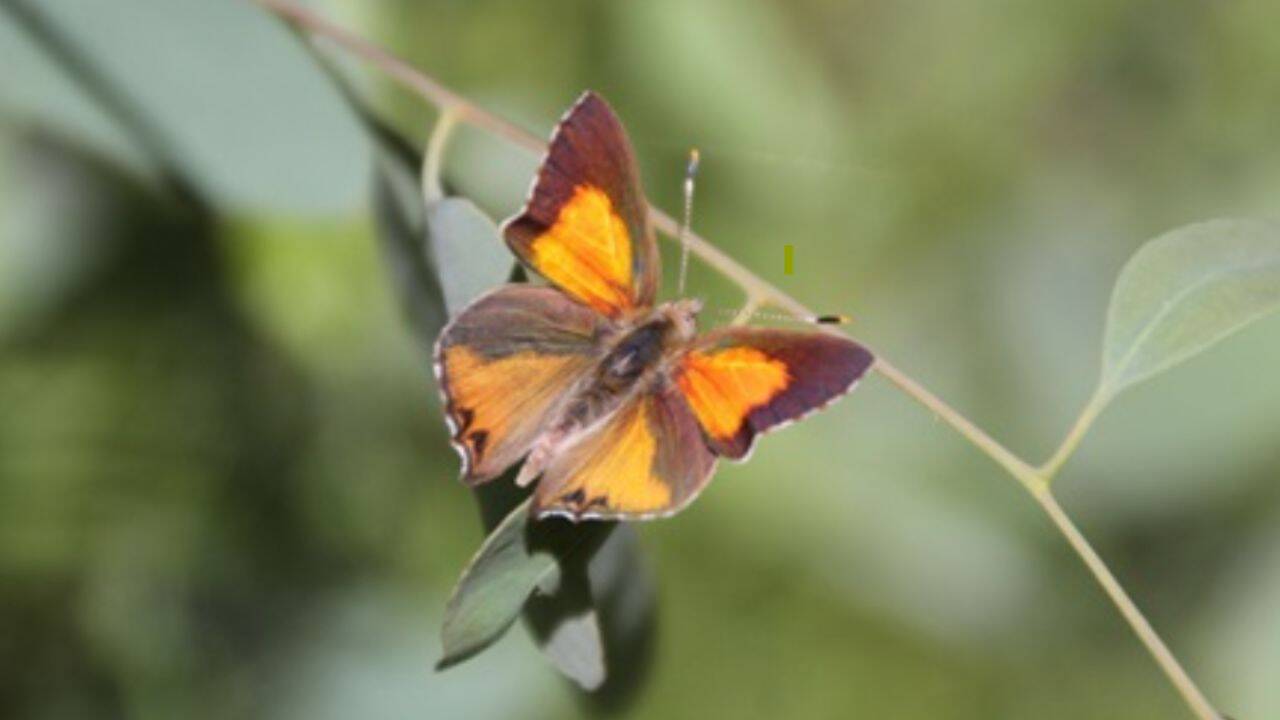
The Eltham Copper Butterfly
Australian butterfly offers hope
As the study highlights widespread habitat changes, one endangered butterfly in Australia has shown signs of recovery through local conservation work.The Eltham copper butterfly was once believed to be extinct until it was rediscovered in 1986. The small butterfly depends on a close relationship with two other native species.Over the years, local residents, the Friends of the Eltham Copper Butterfly, Nillumbik Shire and Yarra Valley Water have worked to restore its habitat by planting native vegetation.Ecological surveys have now recorded nearly a five-fold increase in the number of butterfly larvae found on native plants.Researchers say the recovery shows that habitat restoration can help threatened species, even as climate change continues to reshape where butterflies can survive.