


Indian Railways forms the backbone of the nation’s transport network, linking cities, towns, and remote regions while supporting economic growth and social integration. The Union Budget 2026–27 has given a major boost to railway development, with a strong focus on passenger-centric modernisation, improved safety, and enhanced regional connectivity through record allocations to states. The budget reinforces the role of railways as a key driver of economic expansion, logistics efficiency, and regional integration, as per the PIB press release.

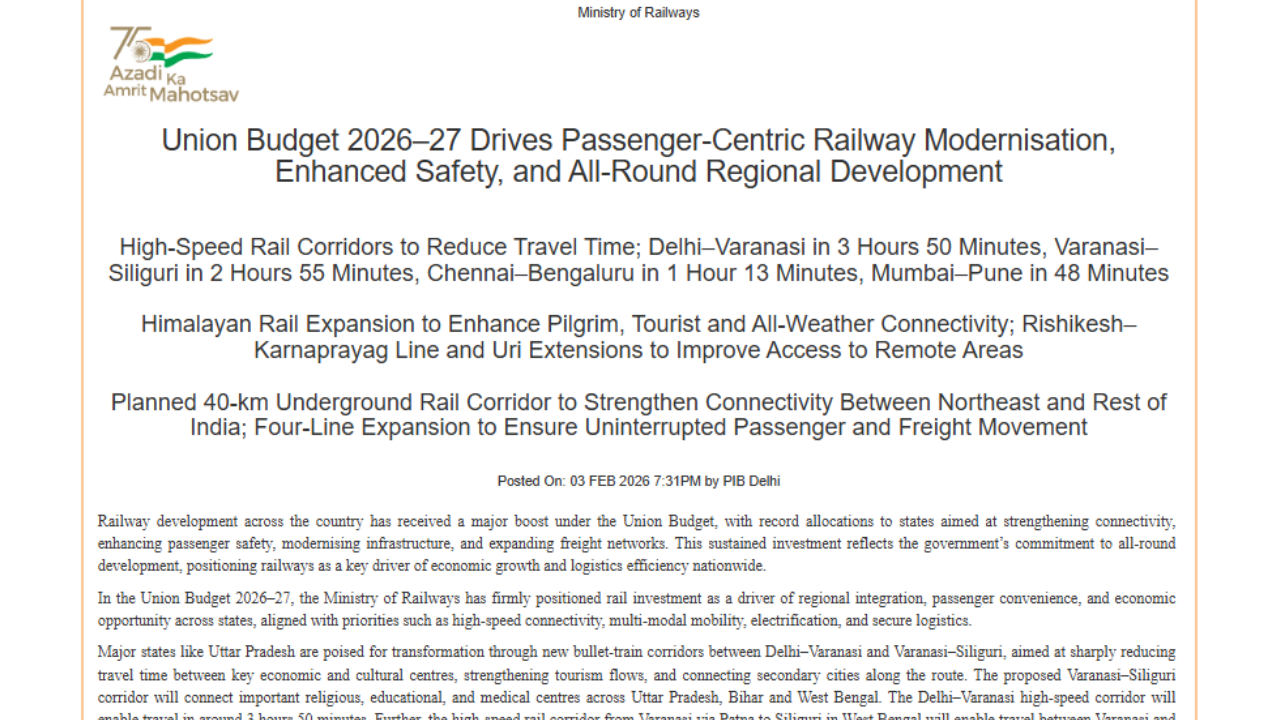
In line with the changes under the Union Budget 2026-27, the Ministry of Railways has placed rail investments centrally to further regional integration, passenger ease, and economic opportunity, all of which emphasize aspects such as high-speed connectivity, multi-modal mobility, electrification, and safe logistics. The changes are directed towards offering greater passenger ease while developing freight corridors. This has been stated in a press release issued by the Press Information Bureau (PIB).Read more: Five new cheetah cubs at Kuno National Park: Why it is a good news for wildlife enthuisiasts One of the notable things about this budget is the strong initiative towards the construction of high-speed rail corridors that could significantly reduce the travel time to different economic, cultural, and religious centers. Of the numerous projects proposed in this budget, it is notable that the bullet train corridor projects such as the Delhi–Varanasi bullet train would reduce the travel time to 3 hours and 50 minutes, while the Varanasi–Siliguri corridor could reduce the time to 2 hours and 55 minutes. The Varanasi–Siliguri high-speed corridor, passing through Patna, will connect important religious, educational, and medical centres across Uttar Pradesh, Bihar, and West Bengal. This corridor is expected to boost tourism, improve access to secondary cities along the route, and create a new economic corridor spanning eastern and northern India, driving regional development and economic activity.

For instance, there are huge plans to develop high-speed rail across southern India, which will allow people to travel between major urban centers much faster. The high-speed rail line proposed between Chennai and Bengaluru would reduce time taken by up to 1 hour and 13 minutes. This can improve connectivity between these two financial centers. The time taken to travel between Bengaluru and Hyderabad may reduce to 2 hours, and between Chennai and Hyderabad to 2 hours and 55 minutes. This rail network has tremendous potential to ignite growth in states like Telangana, Karnataka, Andhra Pradesh, Kerala, Tamil Nadu, and Puducherry.Read more: What’s in Zones 1 to 5 of Ranthambore National Park that’s attracting wildlife tourists? In western India, the Mumbai–Pune high-speed rail corridor is projected to cut travel time to nearly 48 minutes, greatly improving passenger mobility and regional integration. Additionally, connectivity between Pune and Hyderabad could be reduced to around 1 hour and 55 minutes, benefiting both passengers and regional economies. The Union Budget also strongly focuses on upgraded rail connectivity for the Himalayan and north regions. Similarly, efforts like the construction of the Rishikesh-Karnaprayag rail route in Uttarakhand include complex tunneling work and aim to improve accessibility to the region, thereby reducing travel time for pilgrims and tourists. In Jammu and Kashmir, rail connectivity expansions from the region toward Uri are expected to alleviate connectivity issues resulting from harsh winter conditions in those regions.