


NEW DELHI: Pedestrian deaths are not just a city problem. Govt data from 2019-24 shows that highways and other non-urban roads witnessed a large number of such fatalities. Nearly 30% of more than 1.8 lakh pedestrian fatalities were reported on national highways (NHs) while the 50 million-plus cities had nearly 12-13% of all such deaths during the period, as per road transport ministry reports.The remaining deaths were reported from urban roads which are not part the of the 50 million-plus cities, and other roads under classifications such as state highways, district, major and rural roads.The “Road Accident” reports — which collate data provided by state police departments — also show that on an average over 30,500 pedestrians were killed annually between 2019 and 2024, underscoring their vulnerability as the most at-risk category of road users.

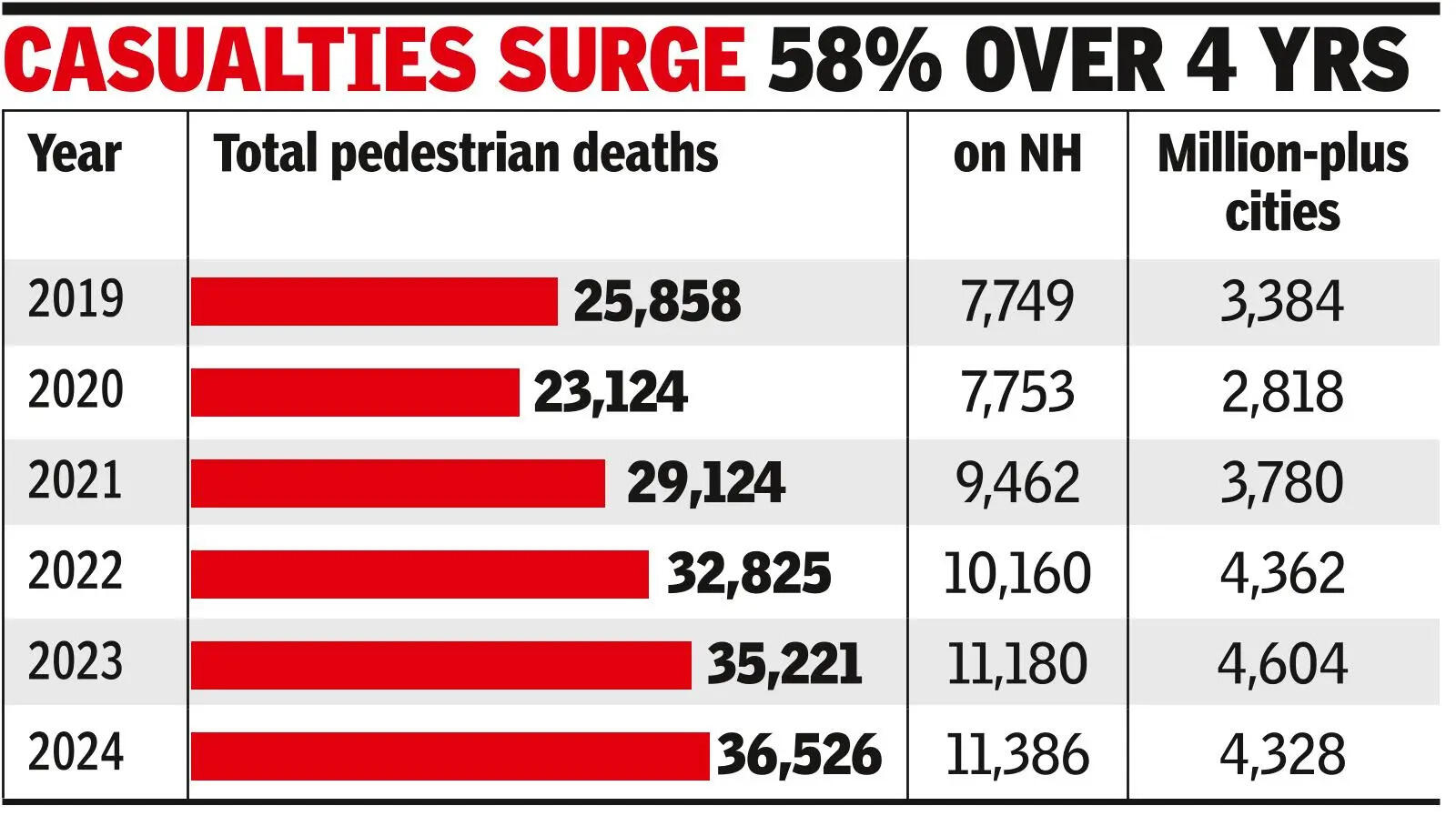
The latest road crash data released by the ministry for 2024 reveals that nearly 54% of 36,526 involved collisions with two-wheelers and cars, claiming 19,680 lives. The trend has been similar in recent years. Road safety experts said this points to how lack of separate and safe footpaths and crossing infrastructure for pedestrians is the biggest reason behind India’s pedestrian fatality toll, which is among the highest globally.This high number of pedestrian deaths calls for attention of policy makers and road construction and maintenance agencies in the light of the latest Supreme Court order upholding right to walk on footpath a fundamental right while directing govt to enact a law for well-demarcated footpaths for all road users. Even last year, SC had said that “rights of pedestrians to use footpaths are guaranteed under Article 21 of Constitution”.The 2024 report shows that Tamil Nadu recorded the highest number of pedestrian deaths (4,712 ), followed by Bihar (4,149), Maharashtra (3,344) and West Bengal (3,241) during 2024.As per the 2024 report, 50 million-plus cities recorded 4,328 pedestrian deaths, which was 11.8% of all such fatalities.“The issue is not the absence of standards but utter failure to implement them on ground. Unfortunately, many city roads are designed almost exclusively for vehicles, forcing pedestrians, including children, senior citizens and persons with disabilities, to walk on the carriageway at considerable risk to their safety. There is a need to extend provisions of pedestrian safety to highways and other roads,” said Abhay Damle, who dealt with road safety as a joint secretary in the ministry.Meanwhile, in another case, which is before SC, an amicus curiae has suggested that govt install signage for pedestrians on highways and also alert them with signs mentioning “pedestrians don’t enter or pedestrians prohibited”.